The United States of America is beautifully diverse and home to families from all kinds of backgrounds.
This means that in their own homes, people are practicing cultural traditions from all over the world that you may know nothing about, even if they are your peers!
The holiday season is an incredible time of year – the cultural fusion of today’s celebrations is a result of decades of migration and globalization, and it’s not going away! It’s important to us to help parents and educators understand some of the complexity so we can help our kids navigate a diverse future.
For a child that looks, behaves, or speaks differently than their peers on the basis of culture, marginalization can occur in multiple ways.
In the classroom, they may be subject to a curriculum that doesn’t tell the story of their heritage correctly or at all, or experience judgment in socializing with their peers.
We want to minimize this isolation and intolerance among children and show them that culture is important, acknowledged, worth practicing, and worth sharing with others.
A Bit of History on the Holiday Season
The holiday season has long been a time of togetherness and community to survive the darkness of winter.
Early populations understood the importance of collective celebration when the days were short and the nights were long and cold, before we discovered electricity!
Through the evolution of humanity and tradition, our annual celebrations have shifted vastly and accommodated major world events and population changes. But the importance of the holiday season is timeless – and has been and always will be cross-cultural.
Regardless of your cultural origin, you likely have strong ties to what you celebrate. America’s pool of multiculturality means people celebrate a blend of holidays based on their unique upbringing, heritage and socialization.
In the United States, the holiday season begins in early November, when Halloween candy goes on sale and the Thanksgiving traditions begin. And while 90% of Americans celebrate Thanksgiving, the reality of the holiday’s origins are significantly overlooked.
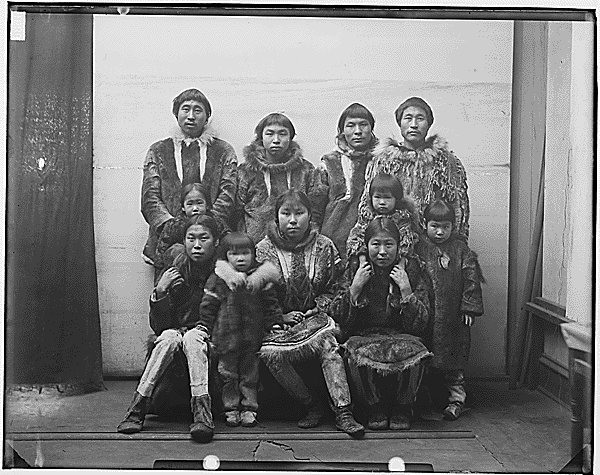
Thanksgiving as a major holiday, especially in early education, celebrates the pilgrimage of the Europeans and ignores the mass erasure of the Native population: atrocities including massacre, displacement and assault.
November is Native American Heritage Month, which is important to recognize and make space for because of its intersectional influence on modern American culture and the cultural trauma that’s brought out this month for millions of families.
It’s so important to make space for what really happened on Thanksgiving to show Native American kids that their history matters just as much as the kids who look like the pilgrims.
This moment also matters deeply in early education because it introduces kids to the erasure of history by America. It’s not something they need to understand perfectly, but giving them the tools early sets the precedent for a media-literate generation.
Decentering the Commercialization of Christmas
In its journey to modernity, the holiday season has become suffocatingly commodified, especially in North America.
But despite the capitalistic pressure its subjects experience each year, the end of the calendar year still represents a time to celebrate togetherness, culture and custom, joy and hope for what’s to come in the next year.
After Thanksgiving wraps up and the clock strikes December 1st, stores rush to put up Christmas trees, curate a holiday playlist, and don their employees in elf uniforms.
This version of Christmas is widely practiced in the states, but the way it’s been commercialized in mainstream media and consumer culture for decades reflects a preference for a Western practice of the holiday, while other cultural practices occurring at the same time may be overlooked.
Cultural Holidays Around the World
Here are a few other ways people celebrate during the holiday season, all over the world, honoring traditions passed down from generations of cultural endurance, globalization and adaptation.
Each of these holidays represents a living story that millions of children in the U.S. bring into classrooms every winter.

Diwali takes place in late October to early November – it’s celebrated by 4 to 5 million Americans each year – it’s also been made an official holiday in California, Connecticut, and Pennsylvania. The 2,500-year-old Hindu festival of lights includes candles, firecrackers, and diya (clay lamps) to symbolize the victory of good over evil, inner light over spiritual darkness, and knowledge over ignorance. Diwali is a time for gathering with loved ones, celebrating life, and committing to making the right decisions in life.
Dia de los Muertos is a Mexican holiday celebrated around November 1. Nearly 40 million Americans claim Mexican heritage. Families create offerings, or ofrendas, to honor their family members that have passed. They celebrate with food, music, and togetherness as if to share a meal with the loved ones who are no longer with them. Some of the biggest Dia de Los Muertos celebrations take place in Albuquerque, San Antonio, Los Angeles, New York, and El Paso.
Bodhi Day is a Buddhist holiday that’s celebrated by the West on December 8th, though in East Asia it falls between the winter solstice and the lunar new year. Bodhi Day commemorates when Siddhartha Gautama achieved enlightenment 2,600 years ago, becoming the Buddha. There are around 4 million Buddhists in America today, and around 24 million Asian Americans. To celebrate, people pray, read scripture, and decorate trees with candles or lights to symbolize the enlightenment process of the Buddha. Other customs include family meals and acts of generosity – some eat rice and milk, believed to have given Buddha the strength to make the final push in his journey to enlightenment.
December 12 is the Feast Day of Our Lady of Guadalupe, marking the day in 1531 when the Virgin Mary appeared to St. Juan Diego in Mexico City. For many, she represented the first apparition of Jesus’ mother in the Americas – this was significant for the indigenous communities of Mexico especially. She serves as a symbol of faith, protection and identity in the development of the country’s history. December 12 is full of festivities, including music, processions, cultural dances and reenactments of Guadalupe’s initial apparition.
Las Posadas is celebrated each year on December 16 – 24. There are 9 days to commemorate the 9 months of Mary’s pregnancy and her search to find somewhere to stay the night (a posada). The holiday originated in Spain but was brought to Mexico through the process of colonization and as a result has become widely practiced in Mexico and the states. On each of the 9 nights, folks sing songs and request lodging until they reach the designated house of the night, where they celebrate with food, prayer and song.
The Dongzhi festival takes place each year on the winter solstice and ignites massive celebrations in China, Taiwan, Japan, Korea, and Vietnam. With origins in Imperial China, 2,000 years ago, the Dongzhi festival is rooted in the ancient philosophy of Yin and Yang, representing the harmony and balance in the universe that occurs on the winter solstice. The holiday is a time to cherish family, nourish the body, and celebrate the changes that will come with the seasons.
Around 15 million Americans celebrate Hanukkah each year, a Jewish festival of lights that lasts 8 days – it often overlaps with Christmas and has thus become a widely practiced holiday in the US. The celebrations represent freedom and the miracle of a day’s worth of oil lasting for 8 days. Festivities include lighting the Menorah each night of Hanukkah, daily reading of scripture, and eating oil-based foods, songs, games and gifts for children.
Kwanzaa, celebrated each year from December 26 to January 1, is a cultural celebration and not tied to any one religion, unlike Christmas and Hanukkah. It’s an African American and Pan-African holiday started in 1966; it’s known as the time to celebrate family and community. Kwanzaa is celebrated with feasts, music and dance, and the holiday ends with a full day to reflect and recommit to the seven principles: unity, self-determination, collective work and responsibility, cooperative economics, purpose, creativity and faith.
Taking Agency in your Child’s Education
Because America is vastly multicultural, it would make sense for legislation to mandate representation of widely celebrated holidays in the United States.
But in public school systems, this is rarely the case. Most curricula feature only Western holidays.
Educators on the front lines find it hard to keep kids engaged in traditions they aren’t actively celebrating.
This can be attributed to the attention span crisis among adolescents, but that’s an entirely different subject. It’s so important to introduce cultural variance early – even an early inclusion of new symbols or music can set a precedent for cultural recognition and tolerance in a child’s development.
Practicing additive education is easy and beneficial for educators, parents and kids alike, but the practice of it in classrooms can often be weaponized as taking away time in class for learning more important curriculum subjects.
To their comfort level, educators and parents alike hold responsibility to expose their children to customs other than their own.
Integrating diverse holiday customs into your child’s media consumption may seem intimidating, or like something you don’t have the time for, but it’s easier than you might think.
It doesn’t have to be extensive, replace any household traditions, or take much out of your pocket.
It can be as simple as checking out a library book about a different cultural holiday, playing music on the drive to swim lessons from a different country, or watching a movie with your child that introduces them to something they haven’t seen before.
Raising curious, compassionate, and informed children is important.

Instilling respect and recognition of cultural customs that vary from their own is crucial to their development.
When learned early, this multiculturality can develop into deeper curiosity and tends to produce more socially adept humans.
As a parent, or someone who works with children, do your best to expose them to more than what exists in their comfort zone.
Teach them about their peers, about the land they live on, their own history, the heritage gifted to them by their parents. If they ask questions about themselves, their peers or the world around them, do your best to answer.
It might require some effort. But raising competent kids always does.
Introduce them early to the complex world that they’ll come to learn more about as they grow.