


Most people don’t even realize June is Men’s Mental Health Month.
It doesn’t get the same spotlight as Pride or Father’s Day.

There are no brand campaigns or themed cupcakes. And that’s part of the problem. Because when men’s mental health is overlooked in general, Asian men fall even further into silence.
We’re often invisible in conversations about masculinity and mental health. Not because we’re unaffected—but because we were never taught how to speak about it.
I know this from experience.
I grew up as the youngest and only son in a Chinese American family. My parents weren’t tiger parents in the strictest sense—no daily punishments or military-style discipline. But they had higher expectations for me than anyone else.
My sisters got praised for trying. I got silence for anything less than perfection.
No one said “don’t cry,” but the message was clear: control your emotions, work hard, and don’t make things harder for anyone else.
That’s how a lot of us grow up. We’re taught to keep it together, to never be a burden, to define ourselves by success.
And then we wonder why we feel so lost.
The Pressure to Be Strong—and the Cost of It
In many Asian cultures, masculinity is synonymous with quiet strength, self-sacrifice, and family responsibility. There’s beauty in that, for sure. But there’s also an underside—one that’s never talked about.

You’re supposed to succeed but not complain.
Provide but not ask for support.
Feel—but never express.
Add to that the Western stereotypes of Asian men as either passive or robotic, and suddenly we’re stuck in a double bind: expected to be stoic providers at home while being overlooked or emasculated everywhere else.
So we cope the only way we know how: we hide it.
We get good at avoidance—burying ourselves in work, numbing out with our phones, distracting with productivity. But avoidance isn’t healing. It’s just emotional debt with interest.
Research backs this up. A study by Iwamoto et al. found that Asian American men who relied on avoidant coping strategies (like denying stress, bottling up emotions, or using substances) reported significantly higher rates of depression.
The more we try to “man up,” the more we break down in silence.
From “Ma Bao” to Magician: Reclaiming Identity Through Archetypes
For a long time, I didn’t even realize how much of my identity was shaped by the Ma Bao dynamic—short for “mama’s boy” in Chinese. My mom loved me fiercely and wanted nothing but the best for me. She checked in on everything: what I ate, who I talked to, what classes I took. Her love was total, and in that love, I was protected—but also a little trapped.
When you grow up with parents who micromanage your path to success, it’s easy to internalize the idea that you can’t—or shouldn’t—fail.
That your worth is tied to performance.
That every decision must factor in what your family thinks. You start outsourcing your sense of self.
That’s how I ended up trying to do everything perfectly: from school to side projects to starting a blog that helps other families navigate parenting and culture (A Tiger Cub). I thought I was building something for myself. But I was still chasing validation.
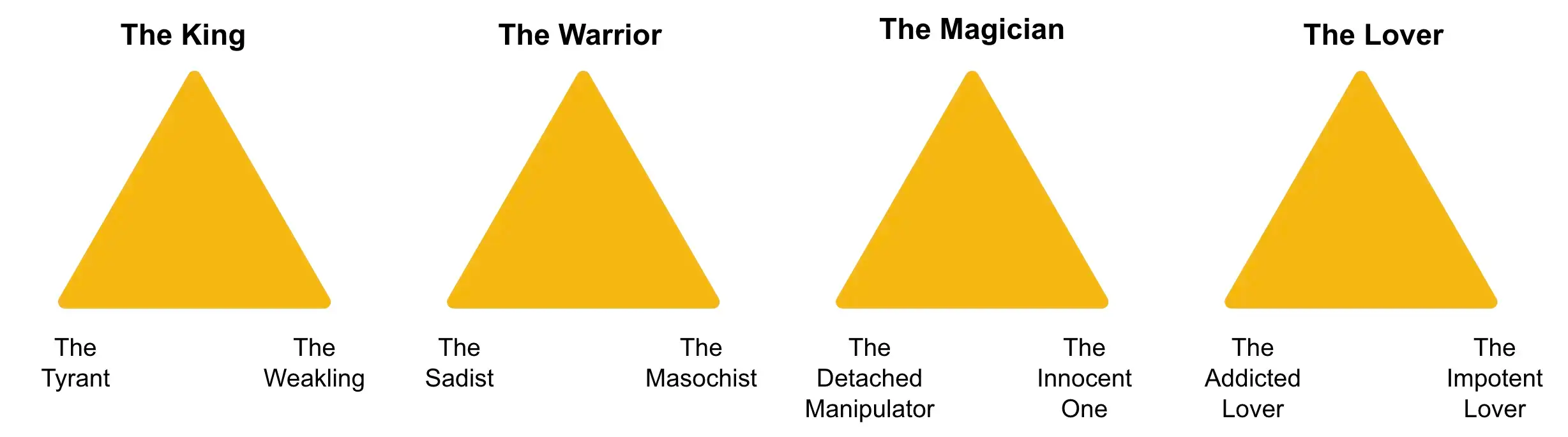
It wasn’t until I started diving into Jungian archetypes that things clicked. There are four classic masculine archetypes: the King, Warrior, Magician, and Lover. Each one represents a different facet of healthy masculinity. And I realized—I had never given myself permission to embody more than one.
The King taught me to lead—not out of ego, but with purpose. Starting A Tiger Cub gave me a vision beyond just making my parents proud. It became something bigger than me.
The Warrior helped me stay grounded through burnout, criticism, and all the emotional growing pains of entrepreneurship. It reminded me that strength doesn’t have to be hard. Sometimes, strength is just showing up again the next day.
The Magician is the one I needed most. It gave me space to reflect, to question, to write. It’s what brought me here—to a place where I can write publicly about things I used to hide.
The Lover—I’ll be honest, this one’s still hard. But I’m learning that vulnerability is a strength. Whether it’s telling my girlfriend how much she means to me or crying during a moment of reflection, it’s a muscle I’m working on.
Reframing masculinity through these archetypes helped me see myself not as broken, but as a work in progress.
Why This Month Matters—Especially for Us
Mental health isn’t just a buzzword. It’s survival. For Asian men, it’s liberation.
Because here’s the thing—when we keep it all in, it doesn’t just hurt us. It hurts our relationships, our future kids, and the communities we lead. When we normalize silence, we pass down the same emotional limitations we inherited.
And I get it—therapy isn’t always encouraged in our circles. For years, I thought it was only for people who were “really struggling.”
But if you’ve ever laid in bed feeling like a failure for no clear reason, or kept pushing yourself until you felt nothing, or struggled to talk about things with your parents without a translator for emotion—then yeah, therapy might help.
You don’t have to hit rock bottom to get support. Sometimes, getting help is how you avoid hitting it.
What Healing Looks Like (Even If You’re Not Ready to Go to Therapy)
Talk to your friends—but go deeper. Don’t just talk about stocks or anime or work. Ask how they’re really doing. Share something vulnerable. Someone has to go first. Let it be you.
Redefine success. You’re not a failure if you’re not rich by 30. You’re not weak if you need to rest. And you’re not a disappointment if you choose a different path than your parents imagined.
Create something. Art, writing, music, code, memes, whatever. Channel your emotions somewhere. Sometimes expression is healing.
Unlearn the shame. You don’t owe anyone an explanation for why you need a break. Or why you cry. Or why you said no.
Find mentors who get it. Whether it’s someone older, or someone online, find Asian men who talk openly about growth, emotion, and identity. They exist.
Final Thoughts: We’re Not Alone Anymore
We’re part of a generation that’s allowed to feel more than just gratitude and guilt. We’re allowed to explore. To mess up. To redefine what it means to be a man in our culture.
This Men’s Mental Health Month, don’t just raise awareness. Raise your voice. Ask the hard questions. Sit with the hard answers.
Because the bravest thing an Asian man can do today isn’t succeed. It’s feel.